Work From Home Furniture in Singapore: What Fits Your Flat, Budget and Routine
A practical guide to work-from-home furniture for Singapore HDB and condo homes, covering dimensions, prices, materials, delivery and setup.
- What size desk actually fits in a Singapore HDB or condo?
- How much legroom do you actually need under a work desk?
- Which work-from-home chair should I buy for a Singapore bedroom?
- Does humidity ruin solid wood furniture in Singapore?
- How do I choose a desk that will last in a small HDB flat?
- How much does delivery and assembly cost in Singapore?
- Which district is easiest for buying and assembling furniture in Singapore?
- How can I build a comfortable work setup without overfilling the room?
- How do I know a work desk is worth the price before I buy it?
What size desk actually fits in a Singapore HDB or condo?
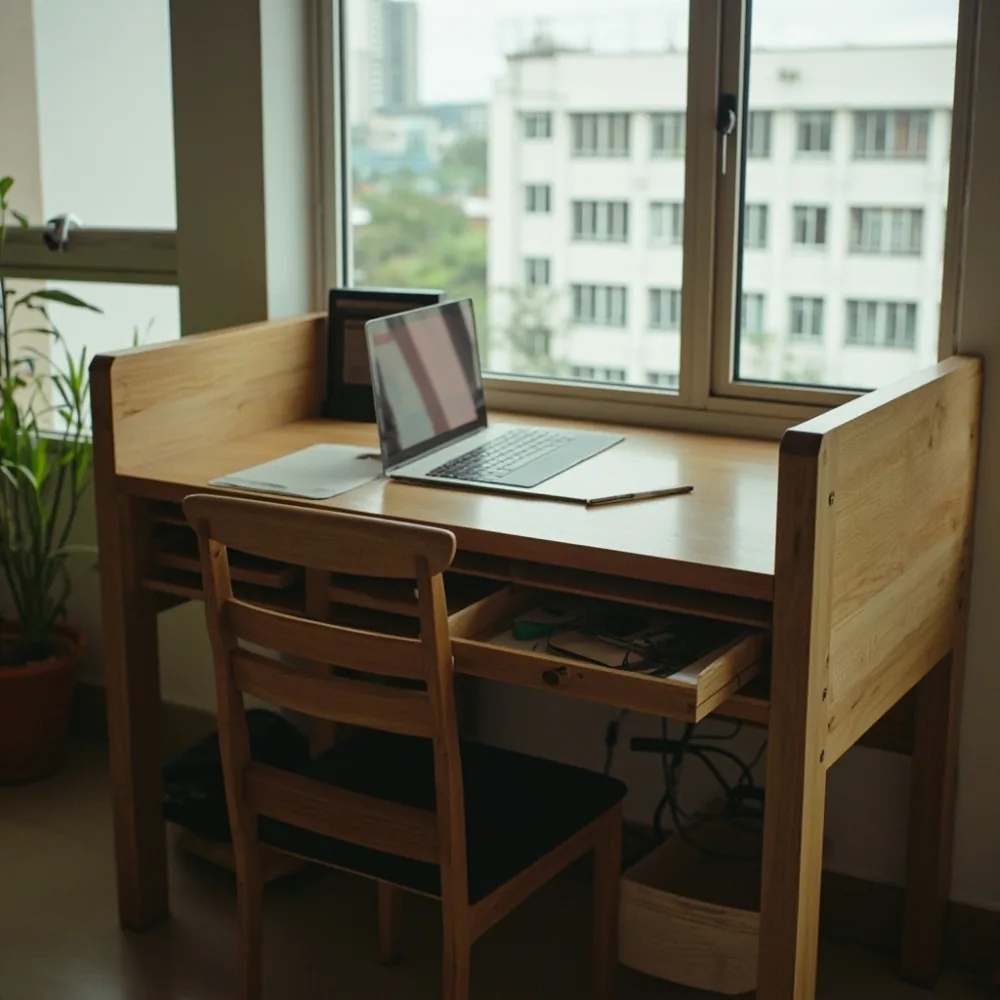
Measure the wall, not just the screen
How I would size different work zones
I start with the space that is genuinely free after daily life, not the empty patch shown in a floor plan. A usable desk needs enough width for a laptop, a notebook and a mug, plus clearance for your elbows. For one person, I prefer 120–140 cm wide and 60–70 cm deep. A 100 cm model can work, but it feels cramped once a monitor stand, documents and charging cables are added.
Singapore homes vary more than the HDB-versus-condo label suggests. A compact HDB study may offer only 90 cm of wall length, while a larger condo room may have a 180 cm wall that still contains a door swing, window or built-in cabinet. Measure the finished wall, skirting and any projecting ledge before buying. The ideal desk depth is at least 60 cm; 70–80 cm is more comfortable if you use a separate keyboard tray or place two screens side by side.
- One monitor, mostly digital work: 120 cm wide by 60–65 cm deep.
- Two monitors or frequent paper handling: 140–160 cm wide by 70 cm deep.
- Very tight study: 100–110 cm wide, with a slim keyboard and monitor arm.
- Shared household desk: allow at least 120 cm per person rather than assuming both users fit shoulder to shoulder.
I would also check the route from the lift to the room. A 160 cm solid wood desk may be elegant on a listing but difficult to manoeuvre through a landing, HDB corridor or narrow condo door. Ask the seller for the longest packaged dimension, not only the assembled dimensions.
| Setup | Recommended size | Target weight capacity | Indicative Singapore price |
|---|---|---|---|
| Compact study | 120 × 60 cm | At least 60 kg | SGD 300–700 |
| Main work desk | 140 × 70 cm | At least 80 kg | SGD 700–1,800 |
| Two-person desk | 180 × 80 cm | At least 100 kg | SGD 1,200–3,000 |
How much legroom do you actually need under a work desk?
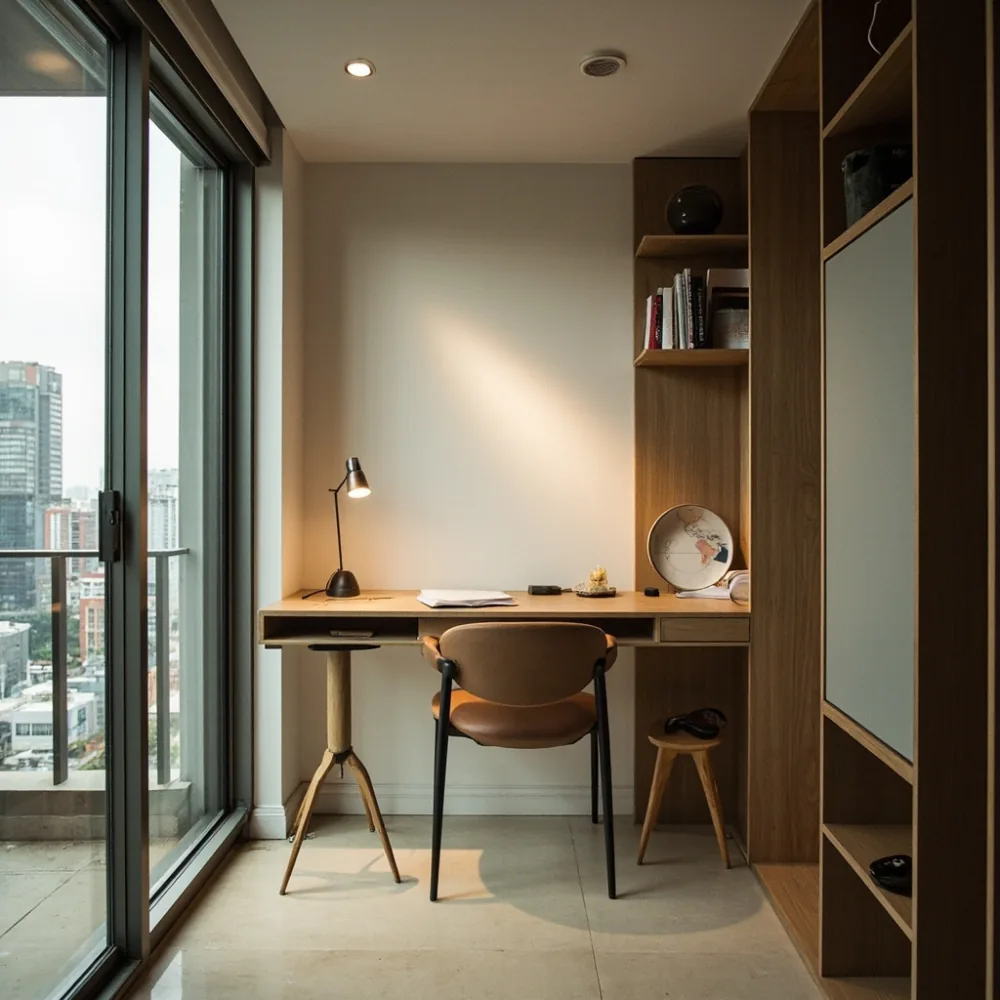
The dimensions that prevent knee and chair problems
When a drawer or cable tray changes everything
Legroom is the part I refuse to compromise on. I want at least 65 cm of clear width and 58–65 cm of knee height for an ordinary office chair. A desk that looks compact in a showroom can leave only 40–50 cm of usable knee space once a modesty panel, drawer or rear support is installed. That forces the chair closer to the table and encourages a bent neck.
Check the desk from a seated position. The keyboard should sit around elbow height, while the monitor should be roughly at eye level. If the chair arms cannot slide under the top, the desk may need at least 75 cm of depth. If you prefer a standing desk, check that the control unit and cables do not reduce foot clearance. Some lifting frames are stable but surprisingly heavy, with assembled weights from 45 to 80 kg.
- Clear knee width: 65 cm minimum; 70–80 cm is better for two screens.
- Knee height: 58–65 cm under the top, allowing room for the chair seat.
- Front edge: rounded or softened if you rest your forearms against it.
- Rear cable tray: keep power bricks off the floor without blocking the footwell.
Small space furniture often solves the visible footprint while making the working position worse. I would rather own one narrow, properly proportioned desk than a large table with a decorative drawer that occupies the space where my knees should be. For compact rooms, a 120 × 60 cm model with open under-table space is usually the safest starting point.
Do not confuse a dining table with a work desk. A dining table may provide a broad surface, but its 73–76 cm height is high for most office chairs, and its sturdy apron can restrict legroom. If a dining surface must double as a workstation, a slim removable laptop riser and a footrest often make it usable, though they are not as comfortable as a dedicated desk.
Which work-from-home chair should I buy for a Singapore bedroom?
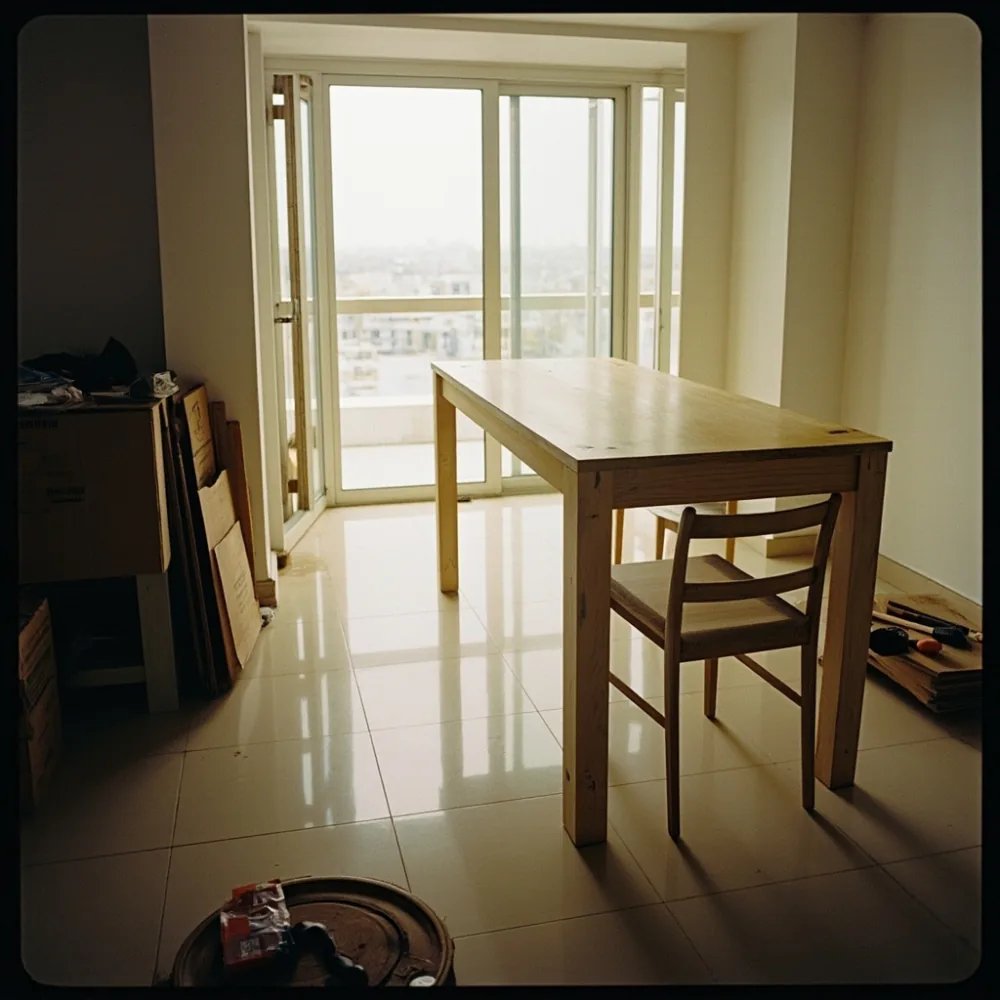
What matters in a small study
How a chair affects your floor space
A work chair is only as useful as the space behind it. Before choosing features, sit down and move the chair back 45–60 cm. If it strikes a wall, cupboard or bed, you may need a compact chair with a shorter back and a smaller base. Full-size task chairs with adjustable armrests are excellent, but a premium mesh chair is not automatically better for a 2.6 m bedroom.
For most home setups, I look for adjustable seat height, lumbar support, breathable mesh and a tilt lock that lets me sit upright. A fixed chair may cost less, but changing position during a long day becomes difficult. I also notice whether the armrests interfere with a narrow desk. If they do, a chair with removable or adjustable arms gives me more freedom.
- Seat height adjustment: around 45–55 cm is a useful range.
- Usual weight rating: 100–120 kg is adequate for many adults; check the actual limit.
- Chair depth: roughly 45–55 cm, plus rolling clearance behind it.
- Base diameter: 60–70 cm is a practical compromise for compact rooms.
A leather sofa is not a substitute for a supportive task chair, although a good lounge chair can work for short reading or informal calls. For daily computer work, I prefer a chair whose seat does not compress excessively and whose back supports the lower back. If noise matters in a condo, check whether the chair wheels have hard castors; rubber or quieter castors are less distracting downstairs.
Budget rather than overspend on the first chair. Many Singapore buyers spend SGD 400–900 on a workable mesh chair, while premium models can exceed SGD 1,500. A chair also needs maintenance: keep the adjustment lever accessible, dust the mesh and confirm that replacement castors are available. Durable furniture means suitable materials and repairable parts, not simply a heavy frame.
Does humidity ruin solid wood furniture in Singapore?
What moves and why
How I reduce warping and swelling
Humidity can affect solid wood furniture in Singapore, but ordinary indoor conditions do not automatically ruin it. Wood naturally expands and contracts as relative humidity changes. The common local problem is not a dramatic flood; it is the slow cycle of humid days, air-conditioned rooms and ventilation gaps. A poorly finished solid wood dining table may develop small movement, surface marks or sticking doors.
I ask sellers about the wood species, finish and warranty rather than relying on the phrase “solid wood”. Teak, ash, beech, walnut and rubberwood respond differently, while a thin veneer over engineered board behaves differently from a solid panel. I also want to know whether the underside and edges are finished. Unsealed undersides can stain through from condensation or cleaning.
- Keep indoor relative humidity around 45–65% where practical.
- Leave 5–10 cm of clearance from walls and air-conditioning vents.
- Use a mat under cups and coasters, especially on pale or matte surfaces.
- Wipe spills promptly with a soft, slightly damp cloth.
- Avoid leaving damp devices, plants or towels directly against wood.
Air-conditioning helps control humidity, but I do not aim at a colder, dryer room than I enjoy sitting in. Direct vent airflow can cause uneven moisture exposure. A simple hygrometer placed near the work zone costs far less than trying to judge the condition by touch. If the reading repeatedly exceeds 65–70%, improve ventilation and move the furniture away from the wall.
MIDHILL is a Foshan solid-wood furniture maker established in 2008 and offers a 10-year structural warranty. That kind of structural assurance is useful when selecting a desk or dining table, but warranty terms still need to be read carefully: finishes, movement and accidental damage may be treated differently from frame failure. I would photograph delivery condition and check the expected moisture-related limits before accepting a large order.
How do I choose a desk that will last in a small HDB flat?
Prioritise stability and serviceability
What I would check before paying
In a small HDB flat, the desk must survive being used as a storage surface, a charging station and occasionally a dining table. I prioritise a stable frame, clean joinery and smooth cable management over decorative drawers. If I need storage, I prefer a shallow pedestal or one narrow drawer under one side, leaving the opposite side open for my legs.
Weight tells me something, but not everything. A solid wood top around 30–50 kg can feel reassuring without being impossible to move. Extremely heavy bases may make the desk difficult to reposition and can stress weaker transport routes. Look for a load rating of at least 60–80 kg and corner connections that resist twisting when you lean on the edge.
For frequent use, I inspect the desktop under good light. Grain should not end in abrupt open pores at an edge, and the surface should be planed rather than aggressively filled. On painted or laminated pieces, look for chips around cable holes and under the keyboard. Hardware should be mounted into solid material or with proper inserts; screws driven only into hollow panels loosen quickly.
Durable furniture also depends on where it is bought. Singapore retailers may offer local after-sales support, while direct imports can have long lead times for replacement parts. I compare the total delivered price, not the showroom price, and ask about returns for assembled furniture. A custom furniture order can be sensible when your room dimensions are unusual, but drawings should specify clearances, cable routes and the exact finished size.
- Ask for the top thickness, frame material and load rating.
- Request photographs of joints, underside and finish samples.
- Confirm whether assembly is included and who handles packaging removal.
- Get delivery and return terms in writing.
| Desk type | Typical weight | Expected useful life | Price range |
|---|---|---|---|
| Compact engineered desk | 18–30 kg | 5–8 years with careful use | SGD 250–600 |
| Solid wood writing desk | 35–60 kg | 10–20 years depending on care | SGD 800–2,000 |
| Adjustable desk | 45–80 kg | 8–12 years before mechanism service | SGD 700–1,800 |
How much does delivery and assembly cost in Singapore?
HDB versus condo access
Delivery questions that prevent surprises
Delivery cost in Singapore depends less on distance than on access. A standard HDB lift usually makes a flat-pack desk easier, but older blocks can have narrow stairs, tight turns or a landing where the driver cannot manoeuvre. Condo deliveries add parking, booking, access-card and sometimes loading-area charges. The building management fee is separate and should not be confused with the furniture carrier’s service charge.
I ask the retailer for the packaged dimensions, number of packages and estimated total weight before checkout. If the desk arrives assembled, I need to know whether the courier carries it into the room, places it at the door or simply leaves it on the ground floor. Stairs and extra handling should be quoted in advance.
- Basic doorstep delivery: often SGD 30–80 within Singapore.
- Room-of-choice delivery: commonly SGD 80–200, depending on access.
- Two-person assembly: roughly SGD 60–150, with some retailers including it.
- Long-item surcharge: possible for desks over 160 cm or heavy solid wood models.
Lead time also matters. Ready-stock furniture may arrive within 3–7 days, while made-to-order pieces can take 4–10 weeks. Peak moving periods and festive closures can add time. For a home office, I usually allow at least 7–14 days from purchase to installation, and more for custom furniture.
Before delivery, I clear the route, measure doorways and protect the floor. For HDB homes, I check whether the lift dimensions can take the longest side of the carton diagonally. In condos, I reserve a loading slot and avoid booking a van that cannot enter the carpark. A good retailer should give a delivery window rather than a vague “next week”.
Which district is easiest for buying and assembling furniture in Singapore?
Why the retail cluster matters
How to compare a local visit with online buying
Singapore’s main furniture districts make it easy to compare frames, finishes and assembly quality in one trip. I am most familiar with the Joo Chiat, Balestier and Kallang areas, where independent showrooms and larger retailers are concentrated. The area around IMM, Sungei Kadut and various home furnishing stores also offers broader selection, though I would plan transport more carefully.
Going in person helps when I need to test a chair, check the grain of solid wood furniture or confirm that a finish feels pleasant under hand. It does not guarantee lower prices. Some online sellers undercut showroom pricing, while a physical store may provide better assembly and after-sales support. I compare the final delivered total, including delivery, installation and any stair surcharge.
- Joo Chiat and Balestier: useful for compact furniture, vintage-style pieces and nearby showrooms.
- Kallang and Geylang: convenient for dining and storage options, with mixed styles.
- Sungei Kadut and IMM: larger-format choices and warehouse-style shopping.
- Online marketplaces: broad price ranges, but expect more uncertainty about finish and delivery.
For a compact Singapore home, I prefer to bring a tape measure, chair dimensions and room photographs when visiting a showroom. I can test whether a desk works with my existing chair and ask for the product sheet on the spot. If I order online, I request close-up images, a finish sample where possible, and a clear cancellation or return policy.
Buying locally does not mean every item was manufactured in Singapore. It means the transaction, logistics and after-sales process are easier to manage here. That matters when a screw is missing or a top arrives scratched. I would rather pay a modest premium for a clear warranty and a realistic delivery appointment than save SGD 100 and spend the difference fixing a poor setup.
How can I build a comfortable work setup without overfilling the room?
Choose one anchor piece
Add storage only where it earns its place
I would begin with three anchors: a correctly sized desk, a supportive chair and task lighting. I resist buying a full matching set before living with the desk for a week. The daily reality of the room reveals what is missing. A monitor arm may be more valuable than a decorative drawer, and a narrow vertical shelf may hold more than a bulky cabinet.
For lighting, I place a task lamp opposite the main hand if I am right-handed and slightly to the left if I am left-handed. A colour temperature around 3,500–4,000 K suits many desk tasks, while brighter daylight should be controlled with blinds rather than darkness. Cable routes should follow the rear or side of the desk, with a reachable power point that is not shared with a blanket or water dispenser.
Storage is where small space furniture can become wasteful. I measure the actual paper and device load, then allow about 20% extra capacity for growth. A drawer around 15–20 cm deep can hold stationery without taking a full cabinet footprint. Open shelving looks light but must be anchored if children or frequent vibration are concerns.
Over a working week, I keep the chair zone clear, remove unused décor and place frequently used items within arm’s reach. This simple discipline makes the desk feel larger. In a living room, I also test the sofa and table combination: a leather sofa may be durable and easy to wipe, but a deep seat can consume the space needed to pull out a dining chair. The goal is a room that supports work, not a showroom staged for a photograph.
| Zone | Clear width | Clear depth | Typical price |
|---|---|---|---|
| Desk and chair | 120–150 cm | 130–170 cm including movement | SGD 700–2,500 |
| Task lighting | 30–45 cm | 15–25 cm | SGD 40–180 |
| Vertical storage | 40–60 cm | 25–35 cm | SGD 100–600 |
How do I know a work desk is worth the price before I buy it?
Compare the full specification
The questions I ask a salesperson
A worthwhile desk earns its price through dimensions, stability, materials and service. I compare similar products by using one checklist: top dimensions, overall height, usable legroom, material, finish, load rating, warranty, delivery time and assembly cost. If two listings look similar, the hidden details usually explain the price gap.
- Does the quoted width include side supports or overhang?
- What is the clear knee width and height?
- Is the top solid wood, veneer, laminated board or engineered timber?
- What load applies to the entire desktop, and how was it tested?
- Can replacement hardware, cables or moving parts be obtained locally?
- What is covered by the warranty and for how long?
I also look for signs of rushed assembly. Uneven gaps, exposed screw heads, rough underside boards and a modesty panel fixed too close to the floor are warnings. A clean underside costs the manufacturer little, but it shows attention to use and maintenance.
For buyers who need an exact fit, custom furniture makes sense when a standard model is within 5–10 cm of the requirement. Beyond that, I would rather adjust the layout than spend heavily on a bespoke piece. Bespoke work often involves a 20–50% premium and a 4–8 week lead time, so the benefit should be obvious in the room plan.
My final test is simple: I imagine a Tuesday evening with several work tasks, two cables and a cup of tea on the desk. If the design keeps those essentials organised without forcing me into an awkward posture, it is likely worth buying. Value is not the lowest number on a website; it is fewer compromises after the furniture has been delivered and used.
Frequently asked questions
What is the best desk size for working from home in a small Singapore room?
A 120 × 60 cm desk is usually the best starting point for one person in a compact HDB room. Choose 140 × 70 cm if you use two monitors or need space for documents. Confirm that the desk has at least 65 cm of clear knee width, then measure the delivery route and the chair’s rolling space before ordering.
Is solid wood furniture suitable for Singapore’s humid climate?
Yes, with sensible placement and care. Solid wood naturally moves slightly as humidity changes, so keep it away from air-conditioning vents and walls, use coasters, and maintain indoor relative humidity around 45–65% where practical. A sound finish, sealed edges and a reliable structural warranty reduce long-term risk.
Should I buy a dining table as a work-from-home desk?
A dining table can work for light laptop use, but its 73–76 cm height may sit high for an office chair, and the apron can reduce legroom. A dedicated 120–150 cm desk usually gives a better working posture. If you must share the surface, use a slim laptop riser and stable chair, and test the setup first.
How long does furniture delivery and assembly take in Singapore?
Ready-stock items are commonly delivered within 3–7 days, while made-to-order furniture may take 4–10 weeks. Allow at least 7–14 days for a complete home-office setup. Confirm whether the price includes room-of-choice delivery, assembly, stair handling and removal of packaging, especially for HDB or condo access.
Questions about sizing, fabric or delivery?
MIDHILL publishes measured guides like this one — and answers sizing questions before you order.
See the collection