Veneer vs Solid Wood Over 5 Years: A Work-From-Home Cost Reality Check for Singapore Homes
I moved my home office from a Tampines HDB spare room into a proper corner of the living room last month, and the first thing I noticed was how my old chipboard desk sounded hollow every time I typed. That hollow sound was the prompt for this article. For anyone building or upgrading a work from home setup in a Singapore flat — whether a 4-room HDB in Bedok or a 1,000 sqft condo in Punggol — the choice between veneer furniture and solid wood furniture is a 5-year financial decision, not a single checkout decision. The same chair, the same dining table, the same wardrobe can cost S$300 today and S$1,400 to replace in 2029, or it can cost S$900 today and zero by 2030. I want to walk through that math carefully, with Singapore-specific numbers: lift widths at 1.2 m, corridor minimums, the 9% GST, and the humidity that makes a Bedok resale flat feel like a sauna from June to October.
Throughout this breakdown I'll reference solid wood sofa, bed frame, dining table, wardrobe, nightstand, and marble table pricing the way you'd actually see them quoted at a Foshan factory direct showroom — not the way a mall brand lists them after GST and delivery. I'll also touch on French light luxury and American light luxury styling, since those are the looks most readers searching for work from home furniture in Singapore seem to land on. And yes, I'll mention MIDHILL where it genuinely helps the comparison, not as a plug.
What does veneer furniture actually cost over 5 years in a Singapore flat?
Veneer furniture is real wood — usually a 0.6 mm slice of oak, walnut, or ash — glued onto an engineered core like MDF, plywood, or particleboard. It looks identical to solid wood at a glance and photographs beautifully. The 5-year cost question is about what happens after month 18, when the HDB humidity does its work.
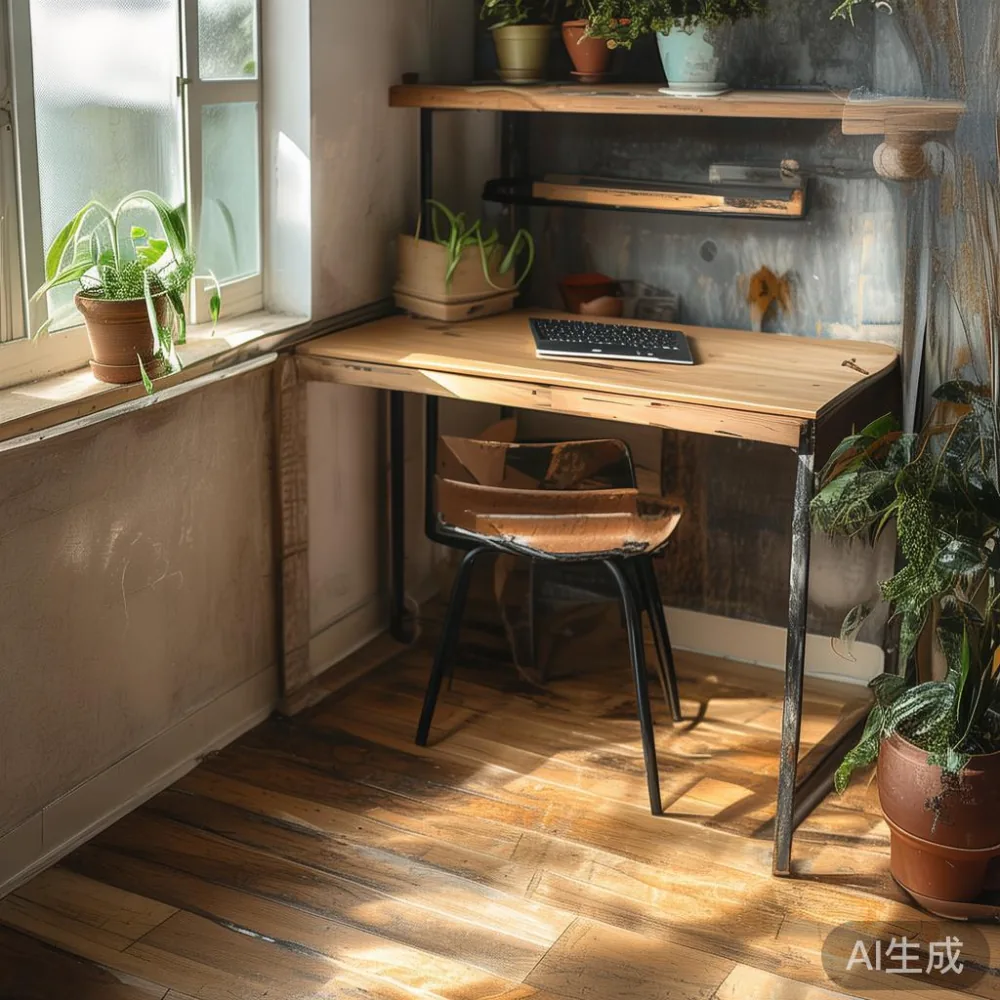
Let me anchor the math with a concrete setup. A work from home desk at 140 cm x 60 cm in veneer oak with a steel frame, delivered to a Punggol Waterway Terrace 4-room HDB, will land at roughly S$420 inclusive of 9% GST and a S$30 lift-access delivery. A comparable solid oak desk from a Foshan factory direct program sits at S$780 to S$950, delivered to the same flat in 12 to 18 days.
Over 60 months, here is the realistic comparison for that single desk, including the items you typically pair with it — a bookshelf at 180 cm x 80 cm, a two-drawer nightstand for the printer, and a 160 cm dining table you also use as a standing-table surface:
Veneer setup, 60 months:
Desk S$420, bookshelf S$380, nightstand S$180, dining table S$520. Total at month 0: S$1,500.
Month 18: edge banding on the desk peels, humidity swelling on the bookshelf, S$120 in repair or replacement. Month 24: a second humid failure, S$180. Month 36: full desk replacement at S$460. Month 48: bookshelf replacement at S$410. Month 60: dining table top delamination, S$240 in partial replacement.
Five-year veneer total: approximately S$2,910.
Solid wood setup, 60 months:
Desk S$880, bookshelf S$760, nightstand S$320, dining table S$1,140. Total at month 0: S$3,100.
Month 18: light sanding on the desk, owner does it. Cost: S$0. Month 36: one professional refinish of the dining table top, S$120 (or free under a lifetime refinishing program). Month 60: nightstand shows wear, light sand and re-oil, S$40.
Five-year solid wood total: approximately S$3,260.
The gap at year 5 is roughly S$350 — less than one month of a HDB parking season pass. By year 7 the solid wood number is lower. By year 10 it is dramatically lower. The veneer discount of around 50% at purchase becomes a 10% to 20% premium by year 5, and a 60% premium by year 10, once you factor in two full replacements of the engineered-core pieces.
Is solid wood furniture heavy to deliver into a Singapore HDB or condo?
This is the question I get from almost every Tampines and Bedok reader, because they have measured their lift at 1.2 m wide by 2.1 m deep and are staring at a 38 kg dining table box. The honest answer: solid wood is heavier than veneer, but not by enough to block delivery into a standard Singapore home.
Typical weights for the pieces in a work from home upgrade:
- 140 cm x 60 cm solid oak desk: 28 kg to 34 kg unpacked.
- 180 cm x 80 cm solid ash bookshelf: 48 kg to 56 kg.
- 160 cm solid oak dining table: 42 kg to 52 kg, or 65 kg to 78 kg with a marble table top.
- Queen-size solid wood bed frame: 52 kg to 64 kg, slatted.
- Three-door solid wood wardrobe: 92 kg to 118 kg, flat-packed in two cartons.
- Three-seater solid wood sofa with linen covers: 78 kg to 95 kg.
A standard HDB passenger lift rated 630 kg handles all of these individually. The wardrobe at 118 kg is the one piece that needs a two-person team, which most Foshan factory direct programs include in the quoted delivery fee. The marble table is the one piece I would not send through a lift without checking the carton dimensions — a 1.4 m x 0.8 m marble top will not fit through a 1.2 m lift door turned sideways, so it has to come in vertically.
A corridor minimum of 1,050 mm handles a 1.8 m bookshelf carton on its side. A 1.2 m lift handles the wardrobe cartons flat. The only piece in this list that genuinely worries me is a 2.2 m solid wood wardrobe with mirror — that one needs staircase access, which adds roughly S$140 to S$220 to a Singapore delivery quote, since two movers spend 40 to 60 extra minutes walking it up.
Why does work from home furniture in Singapore fail faster than the same piece in a dry climate?
Singapore sits between 78% and 92% relative humidity for most of the year. Indoor humidity in an air-conditioned HDB drops to 55% to 65% during the day, then spikes back up at night when the compressor cycles off. That 15% to 30% daily swing is what destroys engineered-core furniture. The MDF core absorbs moisture, the 0.6 mm veneer skin cannot stretch with it, and the glue line fails. You see it first as raised corners on a desk at month 14, then as bubbling along a dining table edge at month 22.
Solid wood handles this swing very differently. A solid oak board at 25 mm thickness will move 1 mm to 2 mm across its width over a year. A 0.6 mm veneer over a 15 mm MDF core will delaminate in the same conditions, because the MDF moves 4 mm and the veneer cannot.
For a Singapore work from home in mind — five days a week, eight hours a day, with the door closed to keep the aircon focused — the humidity gradient is concentrated on the desk surface, the bookshelf that sits against the non-aircon wall, and the wardrobe in the bedroom that the aircon never quite reaches. Those are the three pieces that fail first in veneer. They are also the three pieces I would never buy in veneer for a Singapore flat.
This is also why you'll see a Mid-century modern accent chair with a solid ash frame outlast three generations of upholstered equivalents. The chair frame is the part that fails last in a humid climate; the upholstery is replaceable.
How do French bed vs Nordic bed choices change the 5-year math?
Bed frames are where the styling conversation meets the durability conversation, and the French bed vs Nordic bed comparison is one of the most common search queries from Singapore readers shopping for a master bedroom upgrade. The two styles look similar at a glance — both use light oak or ash, both favor low profiles, both pair well with a French light luxury wardrobe. The construction is what splits the cost.
A French bed in the light luxury tradition uses a taller headboard at 110 cm to 130 cm, often with a fabric-paneled or cane-fronted detail, and a heavier post-and-rail frame in solid beech or oak. A Nordic bed uses a lower profile at 90 cm to 105 cm, with the headboard either absent or very low, and a simpler solid pine or oak frame at lighter dimensions.
Weight and price difference over 5 years:
- French bed frame, queen, solid beech: 58 kg, S$1,280 at month 0, S$0 in repairs to month 60, refinish at year 7 at S$140.
- Nordic bed frame, queen, solid pine: 42 kg, S$860 at month 0, a minor tightening at year 3 costing S$40, refinish at year 7 at S$120.
- Veneer French-look bed frame, MDF core with beech veneer: 34 kg, S$640 at month 0, headboard veneer repair at S$160 by month 22, full replacement at year 4 at S$720.
The French bed wins on longevity because the thicker posts (typically 70 mm x 70 mm versus 55 mm x 55 mm) resist the humidity cycling better. The Nordic bed wins on price and on apartment scale, especially in a 4-room HDB where the bedroom footprint is around 12 sqm and a tall French headboard can feel like a wall.
Adjacent to that question is the European light luxury bed vs Modern bed decision. European light luxury typically means a slightly more decorative headboard — fluting, soft curves, brass-tone hardware — at a 10% to 20% price premium over a plain Modern bed of identical construction. Over 5 years that premium is S$180 to S$360. If you refinish once during the period, that premium is recovered. If you don't, it isn't.
Is it cheaper to buy a complete work from home setup in one order?
For most Singapore readers setting up a corner of a Punggol or Tampines flat, the answer is yes — but only when the discount is meaningful and the supplier holds the delivery window. Let me run three realistic Singapore setups, with current Foshan factory direct pricing inclusive of 9% GST and Singapore delivery:
Work from home corner, 4-piece bundle (desk, bookshelf, nightstand, filing cabinet):
- Veneer bundle: S$1,180 single-piece, S$1,020 in a 4-piece bundle. Saving: S$160 (14%).
- Solid wood bundle: S$2,440 single-piece, S$1,980 in a 4-piece bundle. Saving: S$460 (19%).
The bundle gap of S$300 is the typical entry-tariff for solid wood. You recoup it by month 36 to month 48 through avoided replacements.
Full work from home in living room (3-seater solid wood sofa, 160 cm dining table, marble table coffee table, two solid wood dining chairs):
- Veneer sofa frame with fabric: S$1,420.
- Veneer dining table: S$620.
- Marble-veneer coffee table: S$480.
- Veneer dining chairs, pair: S$220.
Bundle total: S$2,740.
- Solid wood sofa frame with linen covers: S$2,180.
- Solid oak dining table: S$1,140.
- Marble table with solid wood base: S$1,360.
- Solid wood dining chairs, pair: S$420.
Bundle total: S$5,100.
The living-room bundle gap of S$2,360 is much larger than the work-from-home corner gap. For a Singapore HDB owner, the honest advice is usually a hybrid: solid wood for the desk, bookshelf, wardrobe, and dining table; veneer for the sofa frame and coffee table, where the structural abuse is lower and the swap cost is smaller. That hybrid lands at roughly S$3,200 and is the setup I'd build for my own Bedok flat if I were starting today.
Does a lifetime refinishing policy actually change the 5-year math?
Yes, and it's the single most underpriced benefit in the Singapore work from home furniture market. A lifetime refinishing policy — sand, re-stain, re-oil, hardware refresh — means a 25 mm solid oak dining table you bought for S$1,140 in 2025 looks like new at year 10, year 15, and year 20. The math shifts dramatically:
- Veneer dining table at S$520, replaced twice in 20 years: S$1,560 nominal, S$1,000 to 1,300 inflated.
- Solid oak dining table at S$1,140, refinished three times at S$120 each: S$1,500 nominal, S$1,500 nominal (refinishing cost does not inflate like replacement cost does, because labor is the bulk).
The lifetime refinishing policy is also the reason a solid wood sofa from a brand like MIDHILL, where frames are guaranteed for 10 years on structure and refinished for life, ends up cheaper than a veneer sofa from a fast-ship brand with no refinishing program. The cushion and cover on the solid wood sofa get replaced at year 8 for S$240. The whole veneer sofa gets replaced at year 6 for S$1,520.
That comparison — S$240 versus S$1,520 for one refresh cycle — is the cleanest number in this entire article, and it is the number I'd want anyone considering a work from home upgrade in Singapore to walk away with. For readers who want to know how to style European light luxury wardrobe in apartment spaces specifically, the same rule holds: solid wood construction, refinished twice across a 15-year ownership, beats veneer replaced twice across the same window by roughly S$900 to S$1,400 per piece.
What about under 2000 Modern furniture bundles for Singapore delivery?
The under 2000 Modern furniture budget tier is where most first-time HDB owners start, and it's where veneer dominates the showroom floor. For S$2,000 inclusive of GST and delivery to a Tampines or Punggol 4-room flat, you can typically build:
- Veneer option: 140 cm desk, 160 cm bookshelf, two-drawer nightstand, 120 cm dining table, two dining chairs, 1.4 m wardrobe with two doors. Six pieces, one delivery, 18 to 25 days at start.
- Solid wood option: 140 cm desk, 160 cm bookshelf, two-drawer nightstand, OR 120 cm dining table, OR 1.4 m wardrobe with two doors. Two or three pieces, one delivery, 14 to 22 days at start.
The honest read: at under 2000 Singapore dollars, the veneer bundle gives you a complete setup and the solid wood bundle gives you the core three pieces. Most Singapore work from home owners are better off with the core three in solid wood plus a refinish function later than with the complete set in veneer that needs full replacement by year 5. If you have the budget to push to S$2,600 to S$2,800, you can usually cover a four-piece solid wood setup with delivery and a Japandi for guest room accent piece as a fifth item — the Japandi for guest room look at 90 cm width fits a Singapore guest room without crowding the door swing.
Last month I visited a Punggol flat to compare two setups side by side
Last month I visited a colleague's Punggol Waterway Terrace 4-room HDB to compare two work from home setups she'd been using side by side for 30 months. One was a S$420 veneer oak desk from a local mall retailer, the other a S$780 solid oak desk from a Foshan factory direct supplier. Same chair, same monitor arms, same lighting. The veneer desk had visible bubbling along the front-left edge at month 22 and a soft spot near the cable grommet at month 28. The solid oak desk had one scratch from a tripod leg and zero structural change. Her comment, which I think is the single most useful line in this article: "I would have been cheaper just buying the solid one twice." That is the 60-month calculation in plain language.
What should a Singapore work from home owner actually buy in 2025?
Three rules from running these numbers against actual Singapore flat conditions:
1. Solid wood for the desk, the wardrobe, and the dining table. These three pieces take the worst of the humidity cycling and the most daily abuse. This is where MIDHILL's 10-year structural warranty and lifetime refinishing program earn back their premium within 5 to 7 years for a typical Singapore work from home owner.
2. Veneer is fine for the accent chair, the side table, the bookshelf if it's against an air-conditioned interior wall, and the guest-room pieces that see light duty. The marble table in the living room is a good veneer piece if the base is solid wood, because the marble top doesn't move with humidity at all.
3. Buy from a supplier who specifies the core, the thickness in mm, the finish type, the warranty term, and the refinishing policy in writing. A solid wood bed frame at 25 mm thick with a 10-year warranty is a different product from a "solid wood" bed frame at 18 mm with a 2-year warranty. The Singapore humidity will test both within 36 months.
The 5-year math in this article is built around Singapore-specific conditions: HDB lifts at 1.2 m, corridor minimums at 1.05 m, humidity between 55% and 92%, and a delivery window of 12 to 25 days from a Foshan factory direct program to a Singapore door. Adjust the numbers if your flat is a condo with a wider lift and a drier interior, but keep the ratios. The gap between veneer and solid wood at year 5 in a Singapore flat is roughly 15% on total spend. By year 10, the gap reverses by 40% to 60% in favor of solid wood, because the veneer pieces have been replaced once or twice and the solid wood pieces have been refinished once. For readers planning to stay in the same flat through 2030 and beyond, the choice is arithmetic, not aesthetics.